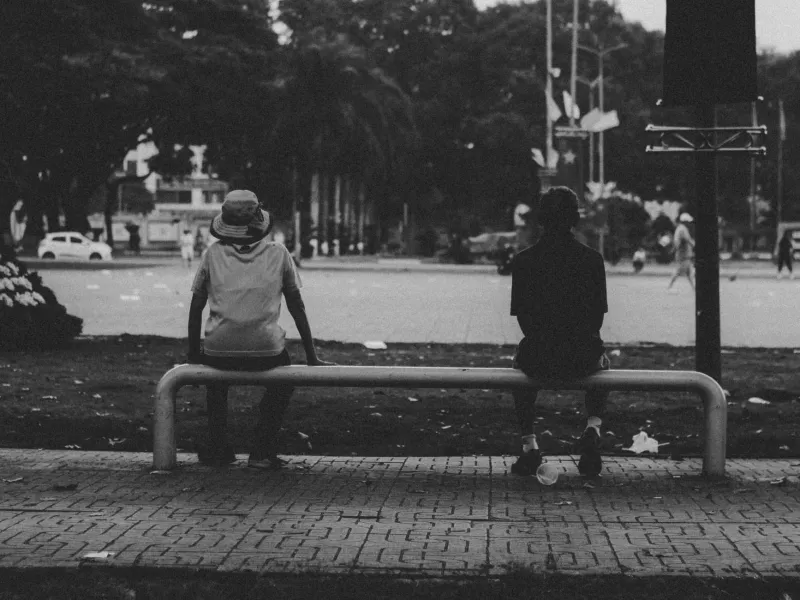
What They're Saying in the Room You're Never In

There's a specific kind of loneliness that nobody really prepares you for. It's not the dramatic, cinematic kind — no tearful monologue, no obvious moment where everything shifts. It's quieter than that. It's the slow realization that you have become, in some rooms, a topic instead of a person.
And topics don't get to hear what's said about them.
The Moment the Dynamic Flips
At some point — and honestly, it's hard to pinpoint exactly when — things changed. There started to be a version of me that existed in conversations I wasn't part of. A version assembled from posts, clips, things I'd said publicly, impressions formed at a distance. That version got discussed, debated, defended, and probably dragged in group chats I'll never see.
What's strange isn't that people talk. People have always talked. What's strange is knowing it's happening and having absolutely no access to it.
Before any of this, if a friend had a take on something I did, there was a decent chance I'd hear it — maybe not immediately, maybe softened a little, but eventually it would surface. That's just how close friendships work. The feedback loop was short. Now? That loop has stretched out into something I can't trace. There are whole threads, whole voice memos, whole dinner table conversations happening somewhere right now where I'm the subject, and I will never know what was said.
You Stop Being a Fly on the Wall
One of the quieter losses that comes with any kind of public presence is the ability to just... blend in. To be in a room — physical or digital — without your presence changing the temperature of it.
I noticed it first in group settings. The way a conversation would subtly shift when something I'd posted recently came up. The way people would glance at me — just for a half-second — before saying what they were going to say, recalibrating on the fly. Not lying, necessarily. Just... editing. Performing a version of their opinion that felt safe to say out loud to me directly.
And I get it. That's human. We all do it. We say different things to people's faces than we do in the backchannel. That's not malicious — it's just social self-preservation. But when you're the one who's become the topic, that normal human behavior starts to feel like a wall you can't see around.
The honest truth is that I have probably lost access to the most accurate read on how people actually perceive me. Not because they're being fake — but because proximity changes candor. Nobody's going to fully roast someone who's sitting right there.
Professional Circles Do This Too
It's not just personal friendships, either. Professional circles do the exact same thing, just with higher stakes and better vocabulary.
In creative and entertainment spaces especially, there's a whole ecosystem of conversation that happens in the margins — the Slack channels, the DMs between collaborators, the casual debrief after a meeting ends. And when you're 'the name people know,' you can feel yourself being managed in those spaces even when nothing explicit is ever said to you.
Opportunities get filtered before they reach you. Opinions get softened. People make decisions about what you can handle hearing. It's not always condescending — sometimes it genuinely comes from a good place. But it still means you're operating with incomplete information about how you're actually landing.
That gap between the curated feedback you receive and the raw conversation happening elsewhere? That's where a lot of misalignment quietly builds up.
The Paranoia Trap
Here's where it gets genuinely tricky: knowing this exists makes it really easy to spiral.
Because once you understand that there's a version of events playing out in rooms you're not in, the temptation is to start filling in the blanks yourself. To project. To assume the worst. To read every slightly-too-long pause or every weirdly-worded compliment as evidence of some whole underground narrative you're not privy to.
That's a trap. A genuinely exhausting one.
I've had to get deliberate about not letting the awareness of what I can't access turn into anxiety about what I'm imagining. Because the truth is, I don't actually know what's being said. Some of it is probably generous. Some of it is probably not. Most of it is probably way more mundane than my brain wants to make it.
The paranoia trap is real, and it's specifically designed to catch people who care about perception — which, if you've built anything public, is probably you.
Learning to Live Without the Full Picture
At some point, you have to make a kind of peace with the incomplete information.
Not a defeated peace — not 'fine, whatever, I don't care.' More like an active choice to anchor yourself in the feedback you can actually verify. The people who tell you hard things directly. The patterns you can observe over time. The relationships where the edit doesn't seem to happen, where someone will actually say the real version of what they think.
Those relationships become genuinely precious. Not because they're always comfortable — they're often not — but because they're one of the few places where you're getting something close to an unfiltered signal.
Everything else? You learn to hold loosely. You accept that there's a version of you living in other people's conversations that you have no control over and limited insight into. And you try not to let the mystery of it hollow you out.
The Weird Gift in All of It
There's something almost clarifying about accepting this, though. Once you stop chasing the full picture — once you genuinely let go of needing to know what's being said in every room — something shifts.
You start making choices based on what you actually believe instead of what you think will land well in the conversation you'll never hear. You stop pre-managing a reputation that's already partially out of your hands anyway.
And weirdly, that's when the people worth keeping tend to show up more clearly. Because they're not waiting for the backchannel. They're saying it to you directly.
That's the room I care about being in.